The Healthcare Staffing Crisis Is a Patient Care Crisis
Healthcare is facing growing financial pressures, workforce shortages, burnout, and rapid technological change. This article explores why healthcare leaders must look beyond productivity and volume when measuring clinical value. Physicians and healthcare professionals are not simply numbers on a balance sheet—their expertise, judgment, and compassion directly impact patient outcomes. The future of
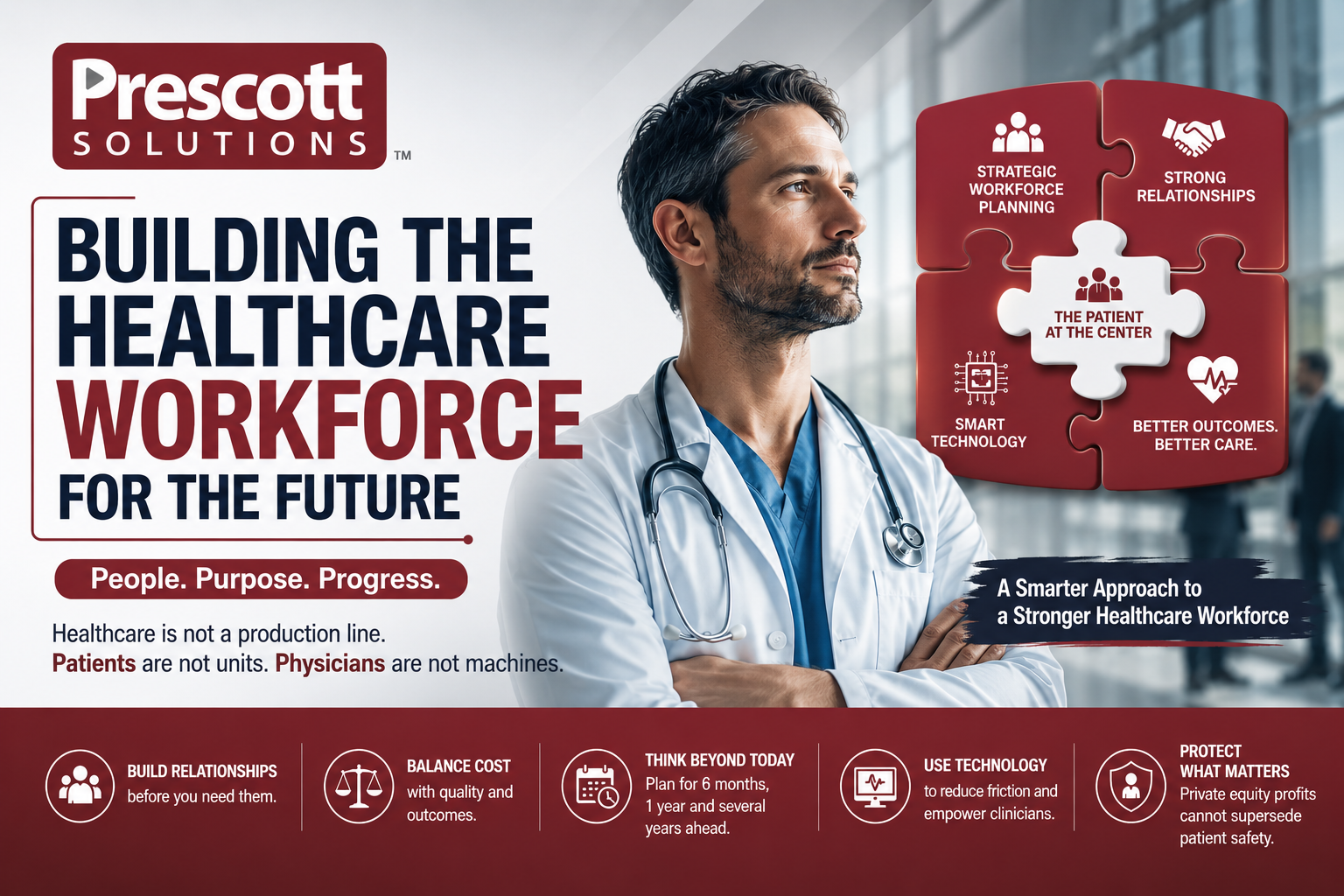
Why healthcare organizations must stop measuring clinical value by volume alone
Healthcare is changing rapidly especially since the introduction of AI.
But in the middle of the financial pressures, workforce shortages, technological disruption and debates over how healthcare should be delivered, I keep coming back to one question:
Where does the patient fit into all of this?
As a healthcare recruiting and workforce solutions executive, I spend a great deal of time thinking about the people behind healthcare delivery. Physicians. Radiologists. Nurses. Technologists. Allied health professionals. The people who make it possible for a patient to receive a diagnosis, begin treatment and, ultimately, get better.
And in 2026, the workforce challenge has become impossible to ignore.
Healthcare organizations are dealing with rising labor costs, reimbursement uncertainty, turnover, staffing shortages and increasing patient demand. Hospital expenses increased 7.1% year over year in the first quarter, while hospital labor costs continued to rise. Healthcare organizations are also facing persistent turnover and shortages across clinical and support roles.
These are not simply financial problems. They are patient-care problems.
A radiologist is more than an RVU
One of the things that has struck me most through my work in physician recruitment is how easily the value of a physician can become reduced to a productivity number.
Let’s take radiology. If you have been a patient or had a family member hospitalized recently, a radiologist has been a vital part of their medical care.
Imagine being a patient in an emergency department. You are in pain. Your physician orders a CT scan because they need to understand what is happening inside your body.
At that moment, do you really care how many RVUs the radiologist can produce in an hour?
Or do you care that the physician reviewing your images is experienced, focused and precise?
I know what mattered most to me and my family in an emergency room situation. That distinction matters.
My perspective on this has also become deeply personal. As someone who has spent the past several months helping care for a loved one navigating cancer treatment, I have experienced healthcare not simply as a professional who recruits the people delivering care, but as a family member sitting on the other side of the system. You notice very quickly that behind every scan, report, treatment decision and hospital encounter is a human being—and a family waiting, worrying, hoping and praying.
Radiologists are not machines sitting behind a workstation moving studies through a queue. Their interpretation can influence a diagnosis, a surgical decision, a cancer treatment plan or whether a patient goes home or remains in the hospital. These decisions affect more than just the patient; they affect an entire family.
Productivity matters. Efficiency matters. Financial sustainability matters.
But volume cannot become a substitute for clinical judgment. Private equity and financial balance sheets are not the final bottom line when it comes to patient care.
The healthcare industry has to be careful about what happens when financial models become so focused on throughput that they lose sight of the human expertise producing the work.
The workforce problem is bigger than radiology
The radiologist shortage does not exist in isolation.
Patient demand continues to increase as the population ages and chronic disease becomes more prevalent. At the same time, experienced clinicians are retiring, younger professionals are reconsidering career paths, and healthcare organizations are competing aggressively for a limited pool of talent.
The workforce pipeline is struggling to keep pace. Moreover, physicians are recognizing their worth and evaluating their own work/life balance and personal realities.
Burnout has not disappeared with the end of the pandemic. In many cases, it has evolved into something more structural: experienced clinicians leaving the workforce, reducing their clinical hours, moving into different roles or deciding that the demands of traditional healthcare practice are no longer sustainable.
That creates a difficult cycle.
Fewer experienced clinicians mean more pressure on the clinicians who remain. More pressure contributes to burnout. Burnout contributes to turnover. Turnover places even more pressure on the remaining workforce.
And eventually, the patient feels the consequences.
Longer wait times.
Delayed procedures.
Slower diagnostic processes.
Reduced continuity.
Less time for communication and patient education.
That is why I don't believe we should talk about healthcare staffing as simply an HR issue.
It is an operational issue, a financial issue and, ultimately, a patient-care issue and thus becoming a systemic issue.
We cannot recruit our way out of a workforce problem we refuse to understand
There is another piece of this conversation that deserves more attention: the pipeline.
If experienced physicians are retiring, we have to ask ourselves a very basic question:
Who are we preparing to replace them? Where is the pipeline going to come from?
We cannot wait until a radiologist retires, a nurse resigns or a physician leaves a community before beginning the search for the next person.
Workforce planning has to become more strategic and more insightful.
Healthcare organizations need to understand where their workforce is going, which specialties are most vulnerable, what their retirement exposure looks like, where their geographic gaps are and which positions are critical to patient access.
Recruiting should not begin when the vacancy appears.
It should begin before the vacancy becomes a crisis.
Technology should support clinicians—not erase them
There is no question that technology will continue to transform healthcare. But will all of that change necessarily make healthcare better? Only time will tell.
Artificial intelligence will play an increasingly important role in imaging, diagnostics, workflow and administrative processes. I believe healthcare organizations should embrace technology that makes clinicians more efficient and reduces unnecessary administrative work.
But we should be equally thoughtful about what technology cannot nor ever replace.
Clinical judgment.
Experience.
Pattern recognition.
Communication.
Accountability.
Compassion.
And the ability to understand a patient within the broader context of their care.
AI may help a radiologist work more efficiently. It may identify findings or assist with prioritization. It may eventually perform tasks we cannot yet imagine.
But healthcare leaders should resist the temptation to confuse automation with expertise and the human heart.
The question should not be, “How much of the physician's work can we eliminate?”
The better question is:
“How can technology help our clinicians spend more time doing the work that requires human expertise?”
Healthcare staffing partnerships need to evolve
This is where I believe recruiting and workforce firms have an important role to play. A good healthcare staffing partner should not be in the business of simply “filling a seat.” That transactional model belongs to another era.
The best partnerships are built on relationships, understanding the organization's clinical needs, knowing the market and understanding the professionals being recruited.
At Prescott Solutions, we approach healthcare recruiting as a workforce partnership.
That means taking the time to understand what a healthcare organization actually needs—not simply matching a resume to a job description.
It means understanding the physician behind the CV.
It means understanding schedule, specialty expertise, geography, technology, compensation expectations, culture and long-term fit.
And it means recognizing that a radiologist, physician or other healthcare professional is not a commodity. They are members of the care team whose expertise can become vital to a patient's outcome. They are a patient’s lifeline of hope and peace.
That distinction becomes even more important as healthcare organizations rely increasingly on remote and flexible clinical models.
Teleradiology, for example, can give hospitals and imaging organizations access to specialized expertise regardless of geography. But remote does not have to mean disconnected. It means more dialed in.
The strongest partnerships create accountability, communication, responsiveness and continuity.
What healthcare leaders should be doing now
Short-term staffing fixes will continue to be necessary. Locum tenens, flexible scheduling, remote care models and technology can all help organizations manage immediate workforce pressure.
But those tools should be part of a larger strategy.
Healthcare leaders should be asking:
1. Where are our greatest workforce vulnerabilities?
Which specialties, locations and clinical functions are most exposed to retirement, turnover or recruitment difficulty?
2. Are we measuring the right things?
Productivity and financial performance matter. But they should be balanced with quality, responsiveness, patient outcomes, physician experience and continuity of care.
3. Are we building relationships before we need them?
The best candidate is much easier to recruit when a relationship already exists. Trust matters.
4. Are we using technology to strengthen the workforce?
Technology should reduce friction and administrative burden so clinicians can focus on clinical work.
5. Are we thinking beyond today's vacancy?
Are we being visionary? Workforce strategy requires looking six months, one year and several years ahead—not simply filling the position sitting open today.
The healthcare workforce is not a production line
I understand the financial realities facing healthcare organizations.
I also understand that hospitals and physician practices have to manage costs. Labor is expensive. Reimbursement is complicated. Margins are under pressure. Technology requires investment.
But there is a line we should be careful not to cross. Private equity profits cannot supersede patient safety.
Healthcare cannot become an automotive assembly line where the goal is simply to move more units through the system faster.
Patients are not units. Physicians are not machines. And clinical expertise cannot be measured solely by volume.
We need financially responsible healthcare organizations.
We need technology.
We need efficiency.
We need strong workforce planning.
And yes, we need accountability.
But we also need to remember why the system exists in the first place.
The patient.
The healthcare workforce crisis will not be solved by one staffing agency, one technology platform or one financial model.
It will require healthcare leaders to think differently about talent—as an investment rather than an expense, as a relationship rather than a transaction, and as an essential part of patient care rather than simply another line on a balance sheet.
That is the conversation I believe we need to have in 2026.
And it is one I intend to keep having.
Sources
Healthcare finance and workforce trends referenced in this article were informed by research and industry reports reviewed by Prescott Solutions, including CommerceHealthcare, Frontera Search, HelloSyncX and Weave.